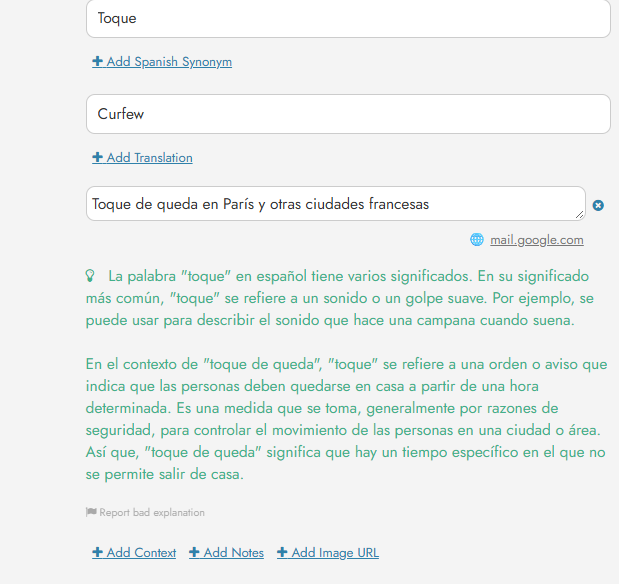
As readlang is evolving, the way that translations are performed and vocabulary stored are no longer reflecting the actual word or phrase that is highlighted, but a an unpredictable and unidentified scope and weight of context. The general idea for understanding the text may be okay, but students will learn incorrect translations and memorize incorrectly translated vocabulary.
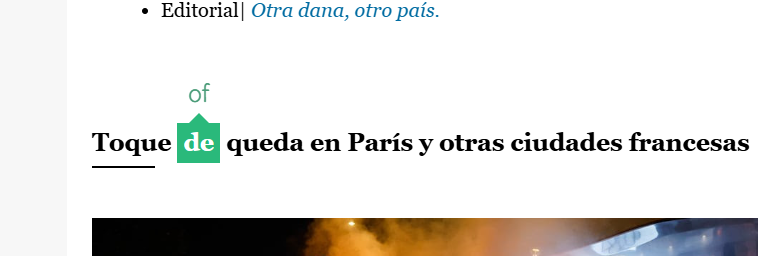
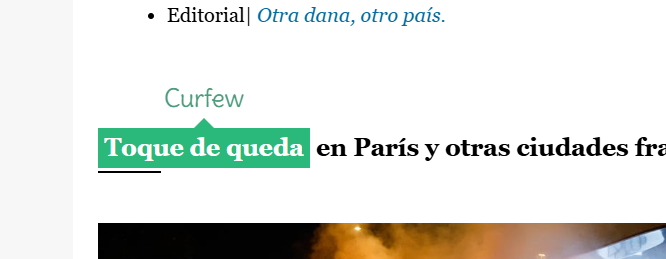
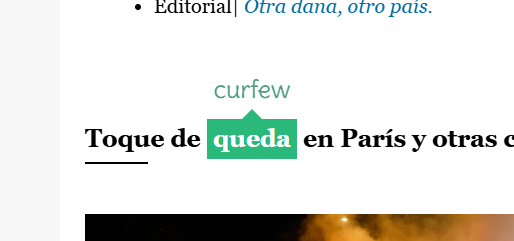
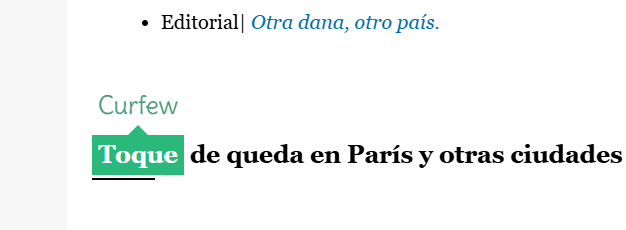
For example in a Spanish text, the phrase “toque de queda” should be translated in English as " curfew ". However, pressing on toque alone will yield curfew, as will highlighting queda alone. In the word list there will be an entry for " toque " meaning curfew, or " queda " meaning curfew when in fact toque means " touch " and " queda " means remain (which before would have been properly translated as individual words when highlighted as individual words).
Readlang was a powerful learning tool in that students could play with how much you highlighted to see how expressions were built. Now, it may help to quickly read a text but it yields too often incorrect translations in the word list that will undermine faith in the tool and the language learning itself. The AI explain then also hallucinates and says that using just one of the words of the phrase is the same as the phrase which is not true and undermines learning yet again.
Yes, this is an issue with the “Context Aware” translations setting. The prompt to the AI probably leads it to try to offer a more insightful definition based on the context, even though assigning the meaning to one word will be misleading. It can even produce a definition that is the opposite of what the word means, due to the word being negated in the context.
Additionally, I don’t care for the way this mode creates multiple definitions under the same word. The extra definitions are usually practically the same thing.
For most languages I don’t think the “Basic Translations” mode is bad.
Have you tried using basic translations? As for myself, I was usually dismayed when the translations were the way you would like them to be.
The point of Readlang is to learn words in context. This is the right approach because no word has a “pure” meaning outside of its context. For a language learner, words are just bundles of meanings that very rarely overlap 100% with the bundles of similar words in other languages. There are no words “touch” and “remain” in the example you gave. Rather, there is only the word “curfew”. I wouldn’t want to try to learn “queda” from a context like this. Also, having three cards from this single expression is not efficient.
I can understand you wanting to see how the words are constructed, though. Could you use the Ask AI setting?
I agree this is potentially misleading, but I also agree with @nakster here that using this sentence to learn the meaning of “toque” and “queda” wouldn’t be that useful. I also agree it’s is a great use of the “Ask AI” feature (link) to give the meaning of all the separate words within a phrase.
I think the best way to deal with this case might be for readlang to translate “Toque” or “queda” as “curfew” but to automatically expand the selection to the whole “Toque de queda” phrase.
I don’t think letting the AI override the selection range is a good idea. That sounds like a crazy loss of user control.
I think if the user does not think “touch” and “remain” make sense in context then they should try highlighting the whole phrase. And sometimes the Explain tab will actually tell you the proper interpretation, although the OP expresses doubt about this.
I would be less bothered by glossing “toque” or “queda” as “curfew” if I didn’t already have any definitions for them. I made a suggestion thread about that…
Yes, the context aware translations in the latest reiterations of the model used and the prompts which are currently utilized seem to want to include random pieces from the sentence and assign them to random parts of the expression. Perhaps useful to read in a foreign language when you are not concerned with exactly which word means what (but much less useful than simply translating the whole text properly if you just want to read it). But, certainly not useful for wanting to learn properly: new vocabulary, the various distinct contextual meanings and nuances of one single vocabulary word and how those words fit within phrases or colloquial expressions.
This is actually a good example of today´s very common problem of LLM AI output. There is no understanding but rather stochastic production of plausible text.: very authoritative answers are often provided for which you have to already be proficient in the domain or in this case the target language to be able to detect that they are actually bullshit.
I have also experienced having the translation be exactly the opposite or wrong due to random application of negation or a transitive object outside of the highlighted text one time and another time not. When students are relying on readlang to provide proper transations and are proceeding directly to memorizing vocabulary, they will be learning lots of incorrect translations. A missed opportunity.
These, however, are exceptions. Often the context specific translation can be spot on. In addition, these translations better take into account local variations in the initial translation (Spanish is notorious for having country or region specific vocabulary and expressions).
I encourage my students to slow down and be very curious about the words that they have in front of them, repeatedly selecting varying amounts of the sentence for translation requests to avoid winding up with lists of individual words with incorrect translations. Perhaps not good for readlang´s inference budget, but really necessary to achieve good results.
I agree that we want help from readlang to read and learn words in all their contextual splendor. But saying that both “toque” and “queda” both independently mean curfew is just wrong. It means that students risk learning competely false definitions of words when they take the next important step to learning vocabulary by actually practicing the words through spaced repetition in the flash and blitz cards.
I wrote my initial message quite hurriedly. In fact, if we are expecting true contextual definitions, then we need to realize that there are in fact 14 different meanings for “toque” and 11 different " frase hechas " or phrasal expressions of which " Toque de queda " is one. https://dle.rae.es/toque In this specific example, highlighting " toque " should give a definition of " warning or call to " and " queda " should yield " gathering / remaining (at home) " while " de " should be translated as it is currently as " of " or even to. Highlighting the phrase " toque de queda " yields the English word curfew, which in Spanish is built up from the words of the warning to stay at home but as a total phrase is equivalent to the definition of the one English word curfew.
This is how I would expect an intelligent translation assistant to operate.
I agree that it would make a lot of sense, especially when it is contextually obvious that the common phrase is the carrier of the complete meaning rather than the individual words, that readlang could or should indicate that (perhaps using a similar pop up box to that used now when pressing on a hyperlink). That would save a lot of wasted time and heartache of students learning wrong translations and missing out on the isomorphic disparity of phrases translating to individual words between languages. Also, individual words may have already been added to the word list, e.g. toque, under one definition. Ideally, we should still be able to add an accurate alternative definition based on the context which readlang should be able to discern.
Agreed, that if you’re just trying to get the meaning of the text then it doesn’t matter that much which meaning gets put on which word. The problem is when you look at your word list later.
I don’t see how this is an example of that. (If you were talking about the Explain tab, then ok.) This seems like it’s clearly a case where the prompt is asking the LLM to answer an impossible question. What does one word mean in context, when it is actually independently meaningless in that context? There is no right answer.
Now perhaps the prompt could be changed, given that you have the below sentiment:
This suggests to me a possibility that context-aware translations are valuable precisely where the word is not part of a phrase of multiple words. I don’t know if that idea is easy to nail down (i.e. in order to write an LLM prompt). In the “word’s meaning gets negated” scenario I’m not so sure I would say that any “phrase” is actually involved, in my experience.
Personally, I’m happy with Basic Translations plus the Explain tab, with the only regret that one can’t configure Basic Translations to hit the LLM instead of Google Translate.
The AI models have now been updated for everyone. The Premium plan now uses GPT-6.1 Terra and Premium Plus uses GPT-6.1 Sol. Both of these do a better job at giving the meaning of the specific word instead of its context, while still taking the context into account. Read more here: Improved AI models for everyone!